Garage Door Replacement Cost by Size: Single, Double and Custom Doors
A garage door replacement can run into several thousand dollars once the door, installation and removal are included. The useful question is what that price buys: a basic door in the existing opening, an insulated upgrade, or a larger opening with building work.
Start with the door’s width and height, then compare written installed prices for the same specification. A door-only listing leaves work to budget for; a two-car garage may have one wide door or two separate doors.
This guide uses U.S. dollars. The prices below identify their size, location and inclusions so you can use them as reference points for a local quote.
What do replacement doors cost?
For an initial product budget, Clopay’s price guide lists these ranges for a solid 8 × 7 ft door, without installation. Clopay describes them as industry-based estimates; they are not a quote for your address.
| Construction | Published price range | Budget boundary |
|---|---|---|
| Uninsulated | $750–$1,500 | Installation is additional |
| Insulated | $900–$2,000 | Construction and options vary |
| Three-layer steel | $1,000–$2,500+ | An insulated construction category, not an extra charge to add to the row above |
For an installed comparison at two sizes, Doors Done Right in New Jersey lists the same Clopay 4050 insulated steel model without windows in its Autumn 2026 catalogs. These are one installer’s regional prices, not national averages.
| Door size | Published installed price |
|---|---|
| 8 × 7 ft single-width door | $1,725 |
| 16 × 7 ft double-width door | $3,050 |
The catalogs include standard installation, new tracks and hardware, perimeter trim, removal and existing-opener hookup, but no new opener. Prices assume cash, check or bank transfer (ACH) and the catalog’s conditional New Jersey tax treatment; confirm your final tax and payment terms. Extra-low ceilings or other site conditions can change the price. See page 5 for the model and page 2 for conditions in the 8 × 7 catalog and 16 × 7 catalog.
These examples serve different purposes. The first helps you understand the product allowance; the second shows a replacement package at two widths. Do not subtract a general product range from a specific installed price to estimate labor. Prices were checked on October 27, 2026; the installer’s written site quote controls the actual job.
Compare single, double and custom doors fairly
A single door: keep the specification fixed
For a straightforward replacement, ask each installer to price the existing opening first. Record the exact width and height rather than writing “one-car door” on the request. The garage door size chart helps you identify the common combinations.
If you are considering a wider opening, obtain separate prices for the door replacement and the opening alteration. A wider door cannot solve a narrow entrance while the opening stays unchanged.
A double door: count openings as well as cars
One 16 ft door is a different package from two 8 ft doors. Two automated singles have two door assemblies and two openers to consider; one wide door has its own specified hardware. Ask for the total project price for each arrangement instead of doubling a single-door advertisement.
Changing from two singles to one double also changes the building opening. Keep that work separate from a like-for-like replacement comparison. Our double garage door guide covers the access trade-offs without treating the center pier as something you can simply remove.
Custom sizes: quote the actual model
A nonstandard width, extra height and a custom decorative design are different requests. Describe each explicitly. Clopay’s FAQ notes that custom dimensions depend on model availability; “custom” does not identify one universal surcharge.
Request the model, ordered dimensions, lead time and installation requirements in writing. Compare an available size that fits the unchanged opening with any proposal to rebuild the opening. Do not apply a percentage premium to an unrelated standard-door price.
Check what the installed price includes
A complete quote should describe the working door system and the work around it. The door panels are only one part of that purchase.
Ask which tracks, springs, rollers and mounting hardware are included. DASMA, the door and access systems manufacturers’ association, explains that the tracks and door sections work together. Existing track is not automatically suitable for a replacement door.
Have the installer identify any proposed reuse and confirm that it follows the new door manufacturer’s requirements. Removal, disposal, perimeter seals and opener connection should also have a clear “included” or “additional” answer.
A replacement door does not automatically require a replacement opener. Ask the installer to assess the existing unit’s compatibility and condition, then price reuse and replacement separately. A low headline price is difficult to judge when it leaves that decision unresolved.
The garage door opener sizing guide explains the compatibility and fit details to confirm before pricing a new unit.
Limited overhead space can change the installation package. Send photographs of beams, ducts and ceiling storage with your inquiry, and use the low-headroom guide to understand why a different track or opener arrangement may need its own quote.
Separate upgrades from changes to the building
If you are still choosing the door itself, compare garage door types and materials before requesting prices. Settle the opening system and complete construction first, so each installer prices the same kind of door.
Choose a baseline door, then ask for each optional upgrade as a separate price. Windows, a different finish and insulation are easier to evaluate when you can see their individual effect on the total. Avoid changing several specifications between quotes and assuming the price difference is all labor.
For insulation, compare the actual construction and thermal information supplied for each model. A label such as “insulated steel” leaves room for substantial differences. The garage door insulation guide explains the performance questions in more detail.
Ask the local building department which approvals and wind or impact requirements apply to the replacement at your address. Have the installer identify the compliant product and any related work in the quote. The Building America Solution Center explains why wind-pressure selection depends on the site and applicable requirements.
Rotten jambs, a damaged opening or a proposed width change deserve a separate scope. Ask who will inspect and price that work, whether the amount is fixed or an allowance, and how additional work will be approved. A door quote should not quietly become an open-ended building repair bill.
Use a worksheet to compare the same job
Before requesting prices, collect the door’s identifying label if it is safely visible, photographs from inside and outside, and the opener’s model number. The garage door measuring guide distinguishes the opening measurements. Let the installer verify dimensions before ordering.
Send the same request to each company. Use this worksheet to identify missing answers; leave unknown amounts blank until the installer confirms them.
| Item to confirm | Quote A | Quote B |
|---|---|---|
| Model, width × height, construction, windows and finish | ________________ | ________________ |
| Required ratings and product documentation | ________________ | ________________ |
| Tracks, springs, hardware and installation labor | ________________ | ________________ |
| Removal, disposal and perimeter seals | ________________ | ________________ |
| Existing opener connection or new opener | ________________ | ________________ |
| Opening repairs or alterations; exclusions | ________________ | ________________ |
| Tax, delivery and permits if required | ________________ | ________________ |
| Total, quote expiry and estimated installation date | ________________ | ________________ |
| Product/labor warranties and payment schedule | ________________ | ________________ |
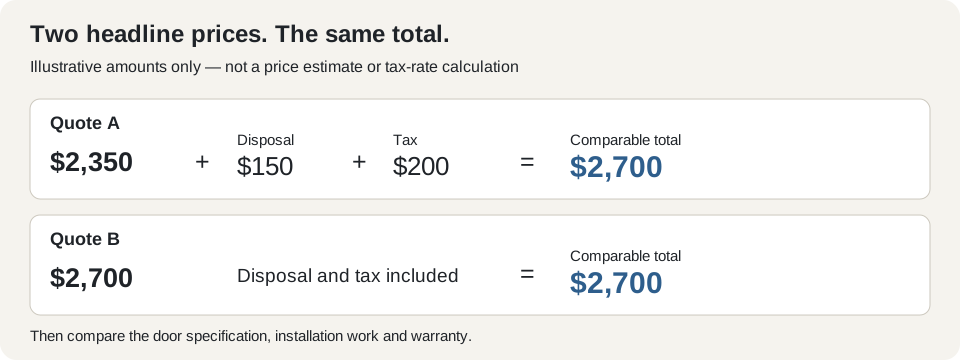
For example, suppose Quote A is $2,350 before $150 disposal and $200 tax, while Quote B is $2,700 including both. Each totals $2,700. These are invented amounts to demonstrate quote comparison, not market prices or a tax-rate calculation.
If an item is marked “allowance,” ask what triggers a change and how the final amount is agreed. If it is marked “excluded,” price it separately when you need it. An unpriced exclusion is not a zero-dollar item.
Common questions
Is it cheaper to replace one damaged panel?
It may be worth obtaining a repair quote. Amarr recommends a professional assessment because the fault may call for servicing, parts, a section or a whole door. Compare the recommended repair with replacement after the underlying problem is identified.
Can I save by taking down the old door myself?
Keep dismantling in the installer’s scope. Springs and connected hardware can store dangerous tension; DASMA recommends trained technicians for installation. Clear stored items from the agreed work area instead of loosening hardware to prepare the job.
Does “two-car garage door replacement” mean two doors?
No. It often describes one double-width door. State the number of openings and each opening’s width and height whenever you ask for prices.
Final Takeaway
Use published prices to set an initial budget, then compare installed quotes for the exact door and opening. Single, double and custom doors need their own specifications; one price multiplier cannot account for the differences.
The most useful quote names the product, includes the required installation work and makes optional upgrades and building repairs visible before you commit.